Abstract
Artificial intelligence (AI) has become increasingly influential in education, healthcare, scientific research, business, and everyday life. Its ability to process large datasets, identify patterns, generate content, and perform specialized tasks has renewed debate about how machine intelligence compares with human cognition. However, intelligence cannot be evaluated through computational speed or task performance alone. Human intelligence encompasses learning, reasoning, creativity, emotional understanding, social interaction, adaptability, and moral judgment, whereas contemporary AI systems operate through computational procedures learned from data or explicitly designed by developers. This article critically examines the similarities and differences between AI and human intelligence, emphasizing their respective strengths, limitations, and practical applications. Drawing on established academic literature and institutional research, it argues that AI can outperform humans in particular well-defined tasks without necessarily reproducing the broader capacities of human cognition. The analysis also considers algorithmic bias, privacy, accountability, and the social consequences of automation. It concludes that responsible collaboration between humans and AI offers greater practical potential than treating either form of intelligence as universally superior.
Keywords: artificial intelligence, human intelligence, machine learning, cognitive abilities, creativity, emotional intelligence, ethical decision-making, human–AI collaboration
1. Introduction
Intelligence has traditionally been associated with the ability to acquire knowledge, solve problems, learn from experience, and adapt to changing circumstances. The development of artificial intelligence has complicated this understanding by demonstrating that machines can perform tasks once considered dependent on human intellectual abilities. AI systems can translate languages, recognize patterns in medical images, generate written content, and assist researchers in analyzing complex information.
Nevertheless, successful performance on a particular task does not necessarily indicate intelligence equivalent to that of a human being. Russell and Norvig (2021) explain that AI encompasses different approaches to building systems capable of performing tasks associated with intelligent behavior. Human intelligence, by contrast, develops through interactions among biological processes, experience, perception, social relationships, and environmental conditions.
The comparison therefore requires more than identifying which system produces faster or more accurate answers. It must examine how intelligence is acquired, how decisions are made, whether knowledge transfers across unfamiliar situations, and how emotional and ethical considerations influence behavior. This article argues that AI and human intelligence represent different but potentially complementary forms of problem-solving capability. Their relative effectiveness depends on the task, the surrounding conditions, and the consequences of error.
2. Concept of Artificial Intelligence
Artificial intelligence refers to computational systems designed to perform tasks involving capabilities such as prediction, language processing, perception, planning, and decision-making. Modern AI includes machine-learning techniques, in which systems identify statistical relationships from data, and deep learning, which uses multilayered computational models to learn increasingly complex representations.
Generative AI extends these capabilities by producing outputs such as text, images, computer code, and summaries in response to instructions. Large language models, for example, learn patterns in language during training and use those patterns to generate contextually appropriate responses. Their outputs can be useful and sophisticated, but fluent communication alone does not establish that a system understands a situation in the same way a human does.
A major strength of AI is its capacity to analyze substantial quantities of information consistently and rapidly within suitable computational environments. However, its performance depends on the quality of its training data, the design of the model, the task being evaluated, and the conditions under which it operates. AI systems may produce incorrect information, reflect historical biases, or behave unpredictably when presented with unfamiliar inputs.
Consequently, AI should be understood as a diverse collection of technologies rather than a single, unified intelligence. A system designed to detect patterns in medical images, for instance, should not automatically be assumed capable of making sound legal judgments or understanding an individual's emotional circumstances.
3. Concept of Human Intelligence
Human intelligence involves interconnected cognitive abilities, including perception, memory, learning, reasoning, language, creativity, planning, and problem-solving. Unlike narrowly trained computational systems, people commonly combine knowledge from different areas and use contextual information to respond to circumstances that have not been encountered before.
Human cognition is also embodied and socially situated. People learn through direct experience, observation, relationships, experimentation, and cultural participation. Their judgments are influenced by personal goals, emotions, beliefs, and accumulated experiences. These influences can support effective decisions, although they can also introduce prejudice, inconsistency, and cognitive bias.
Human intelligence should not, however, be idealized. People make factual errors, forget information, struggle with complicated calculations, and sometimes reach conclusions influenced by misleading evidence. Human expertise varies considerably, and even experienced professionals may disagree when information is incomplete.
An important distinction is that human intelligence operates within a broader network of biological needs, social responsibilities, and lived experiences. This makes human cognition particularly relevant to situations requiring interpersonal understanding, contextual interpretation, and accountability. It does not mean that every human judgment is superior to an AI-generated recommendation.
4. Key Differences Between AI and Human Intelligence
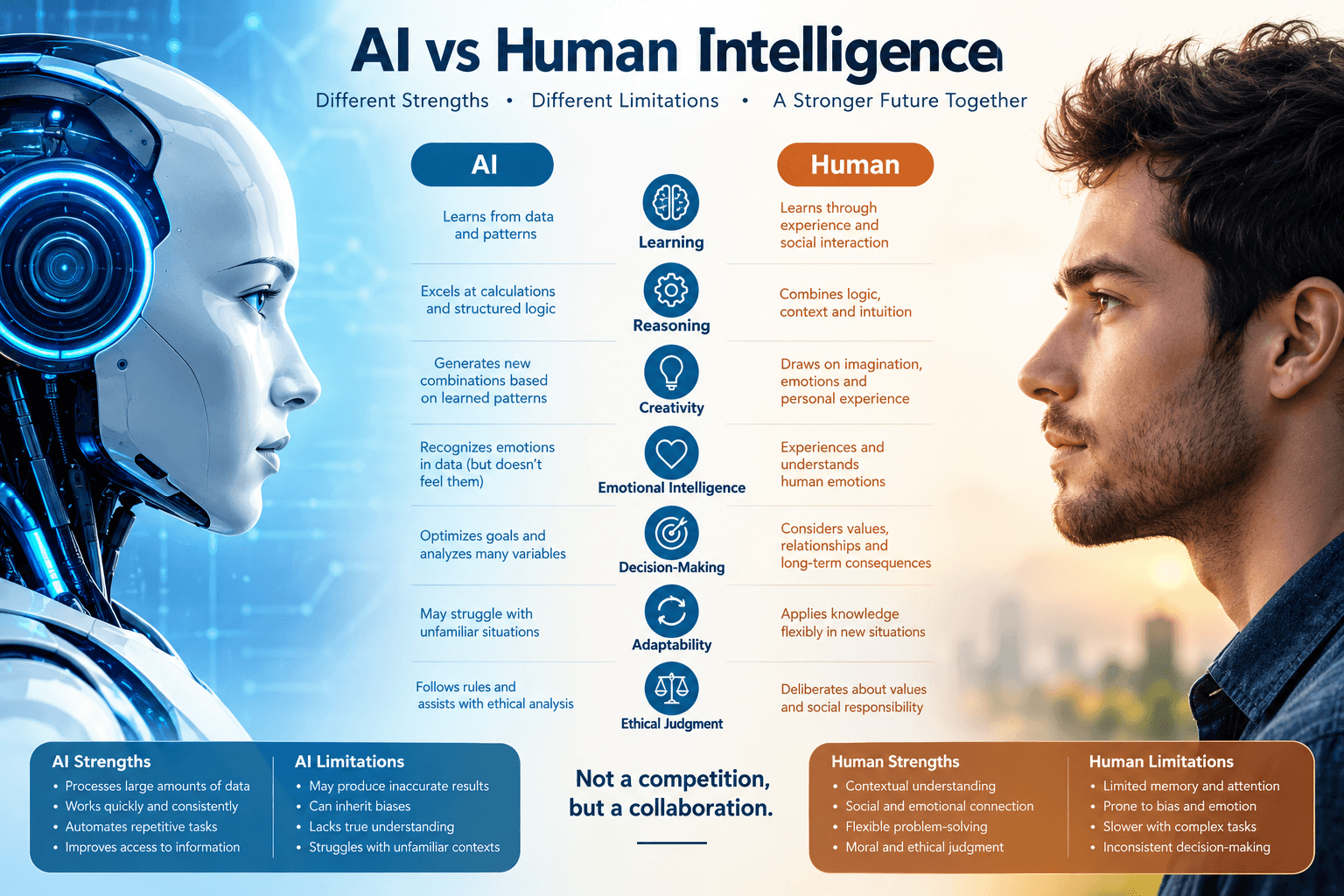
The following table summarizes the key differences between artificial intelligence and human intelligence across several important dimensions.
| Dimension | Artificial Intelligence | Human Intelligence |
|---|---|---|
| Learning | Learns patterns from data, feedback, and computational models. | Learns through experience, observation, instruction, and social interaction. |
| Reasoning | Performs calculations and structured reasoning but may produce inaccurate conclusions. | Combines logic, context, experience, and intuition, although it can be biased. |
| Creativity | Generates new combinations and ideas based on learned patterns. | Draws on imagination, personal experience, emotions, and cultural understanding. |
| Emotional Intelligence | Identifies emotional patterns in language and behavior without necessarily experiencing emotions. | Experiences emotions and interprets social situations through lived experience. |
| Critical Thinking | Compares information and identifies inconsistencies when appropriately designed and prompted. | Evaluates evidence, questions assumptions, and revises conclusions through reflection. |
| Decision-Making | Analyzes many variables and optimizes clearly defined objectives. | Considers values, relationships, consequences, and contextual responsibilities. |
| Adaptability | May struggle when situations differ significantly from training conditions. | Can often apply previous knowledge to unfamiliar situations. |
| Ethical Judgment | Applies specified rules and supports ethical analysis but cannot guarantee morally appropriate outcomes. | Can deliberate about competing values and accept social or professional responsibility. |
These differences are general tendencies rather than absolute rules. AI capabilities continue to develop, while human performance varies according to knowledge, experience, and circumstances.
4.1 Learning and reasoning
AI systems can identify complex statistical patterns that are difficult for humans to detect manually. Nevertheless, learning from large datasets is not identical to learning through a small number of meaningful experiences. Human learners can sometimes use contextual understanding to infer a general principle from limited examples.
Reasoning also depends on the problem. AI may excel at calculations, searching large information spaces, or applying formal procedures. Humans may be better positioned to recognize when a question is poorly framed, when important information is missing, or when the apparent objective conflicts with broader needs. Neither capability guarantees correctness.
4.2 Creativity and critical thinking
AI-generated outputs can be novel in their immediate form and useful in artistic or scientific work. Boden (2004) distinguishes forms of creativity involving the exploration of possibilities, the combination of existing ideas, and the transformation of conceptual frameworks. This distinction helps explain why generating an unfamiliar combination is not necessarily equivalent to developing a meaningful new direction.
Human creativity can be informed by emotion, personal intention, cultural experience, and a desire to challenge existing assumptions. AI can support brainstorming and generate alternatives, but the originality, usefulness, and significance of its outputs still require evaluation.
Critical thinking similarly involves more than producing plausible arguments. It requires checking evidence, identifying assumptions, considering counterarguments, and revising conclusions when necessary. AI can assist with these activities, but its confident presentation may obscure factual errors. Human oversight is therefore especially important when the cost of misinformation is high.
4.3 Emotional intelligence, adaptability, and ethical judgment
Humans experience emotions and participate in relationships that shape their understanding of trust, distress, cooperation, and responsibility. AI can recognize linguistic or behavioral indicators associated with emotional states, but this capability should not be confused with demonstrated subjective emotional experience.
Adaptability presents another distinction. People can often transfer knowledge between everyday situations without requiring a complete redesign of their learning process. AI systems can generalize beyond their training examples, but the reliability of that generalization depends on the model and the environment.
Ethical judgment is more complicated still. A computational system can apply rules or compare possible consequences, yet ethical decisions involve contested values, social inequalities, rights, and responsibilities. These considerations cannot be resolved simply by maximizing a numerical objective.
5. Strengths and Limitations of AI
AI offers several significant advantages. It can process large datasets, automate repetitive operations, provide rapid feedback, and operate consistently when tasks are clearly defined. It can also improve access to information, assist people with disabilities, support language translation, and help researchers explore hypotheses.
However, these advantages must be considered alongside important limitations.
First, AI systems may generate plausible but inaccurate statements. Second, models trained on unrepresentative or historically biased data can reproduce discriminatory patterns. Third, many systems provide limited explanations of how particular outputs were produced. Fourth, performance may deteriorate when real-world conditions differ from the data or assumptions used during development.
The National Institute of Standards and Technology emphasizes that trustworthy AI requires attention to validity, reliability, safety, security, transparency, accountability, privacy, and fairness (Tabassi, 2023). These requirements demonstrate that technical performance alone is insufficient. A system can achieve strong results on a benchmark and still be unsuitable for a particular real-world application.
AI also depends on human institutions and infrastructure. Its development and operation require data, computing resources, maintenance, evaluation, and governance. Automation may reduce some forms of labor while creating new responsibilities and potentially displacing workers. Therefore, AI's benefits should be evaluated alongside its economic, environmental, and social costs.
6. Strengths and Limitations of Human Intelligence
Human intelligence has important strengths in contextual understanding, social interaction, moral deliberation, and flexible problem-solving. People can consider personal histories, interpret ambiguous situations, negotiate competing priorities, and recognize that a technically correct answer may be inappropriate in a particular human context.
Human beings also possess the capacity to reflect on their own assumptions, learn from mistakes, and revise their values through discussion and experience. These capacities are particularly important in education, leadership, healthcare, and public decision-making.
Nevertheless, human intelligence has limitations. Human attention and memory are finite, and complex calculations or extensive document reviews can be slow and error-prone. Judgment may be distorted by stereotypes, emotional pressures, overconfidence, fatigue, and selective attention. Experts can also struggle to recognize the limits of their own knowledge.
Furthermore, access to high-quality education, professional expertise, and information is uneven. Human decisions are therefore not automatically fair or reliable simply because they are made by people.
The appropriate comparison is not between perfect human judgment and flawed machines, or between flawless machines and irrational people. It is between different systems of capability, each of which requires suitable conditions, evaluation, and correction.
7. Applications and Real-World Examples
7.1 Education
In education, AI can help explain difficult concepts, generate practice questions, provide language assistance, and offer feedback on written work. These functions can support personalized learning and make educational resources more accessible.
Kasneci et al. (2023) discuss both the opportunities and challenges of large language models in education, including their potential to support teaching and learning and the need to address reliability, bias, and academic integrity. A student who uses AI to explore alternative explanations may benefit, whereas a student who relies on generated answers without evaluating them may miss opportunities to develop independent reasoning.
Teachers contribute subject expertise, encouragement, classroom awareness, and knowledge of students' individual circumstances. A productive approach uses AI to support learning while preserving human instruction, independent practice, and meaningful assessment.
7.2 Healthcare
Healthcare illustrates why complementary capabilities matter. AI can assist with medical-image analysis, risk prediction, clinical documentation, and the interpretation of large datasets. Topol (2019) argues that appropriately developed AI has potential to improve aspects of medical practice while allowing clinicians to focus more attention on patients.
Nevertheless, clinical decisions require more than pattern recognition. A healthcare professional must consider symptoms, medical history, treatment preferences, uncertainty, and the patient's circumstances. An algorithmic recommendation may be misleading if the patient differs from the population represented in its training data.
The World Health Organization (WHO, 2021) therefore emphasizes human rights, safety, transparency, accountability, and the protection of human autonomy in the governance of AI for health. AI should support appropriately supervised clinical decisions rather than automatically replace professional responsibility.
7.3 Scientific research
AI can assist scientists by identifying patterns, processing experimental data, screening publications, and generating candidate hypotheses. These capabilities may accelerate stages of research that would otherwise require substantial manual effort.
Human researchers remain essential for formulating meaningful questions, selecting appropriate methods, evaluating evidence, designing experiments, and determining whether a finding is scientifically significant. AI-generated hypotheses must be tested, and computational results require independent verification. Speed is valuable only when accompanied by methodological rigor.
7.4 Everyday life
Everyday applications include navigation, recommendation systems, translation tools, accessibility technologies, and digital assistants. Such systems can simplify routine decisions and help people manage information.
However, recommendations may narrow exposure to alternative viewpoints, automated systems may collect sensitive data, and generated answers may omit important context. Users benefit when they understand the limitations of these tools and retain control over consequential decisions.
8. Ethical and Social Implications
The increasing use of AI raises ethical questions that extend beyond technical accuracy. One major concern is algorithmic bias. If training data reflect existing inequalities, AI-assisted decisions may reproduce or amplify those inequalities in areas such as recruitment, lending, education, and healthcare.
Privacy is another concern because AI applications may process personal communications, images, health records, or behavioral information. Responsible deployment requires appropriate data protection, informed consent where applicable, and clear limits on the collection and use of personal information.
Accountability becomes particularly difficult when several parties contribute to an AI-assisted decision. Developers design systems, organizations select how to deploy them, and professionals may rely on their outputs. Responsibility should therefore be assigned through clear institutional procedures rather than shifted onto an algorithm.
Employment and education also require attention. Automation can change the tasks people perform, creating opportunities for some workers while placing pressure on others to acquire new skills. Institutions should support accessible training and evaluate the distribution of benefits and costs.
The NIST AI Risk Management Framework identifies governance, risk assessment, measurement, and management as important components of responsible AI practice (Tabassi, 2023). In healthcare, the WHO (2021) similarly stresses that AI governance should protect human autonomy and promote public benefit. Together, these approaches suggest that responsible AI requires continuing oversight, not merely a one-time technical assessment.
9. Future of AI and Human Collaboration
The future of intelligence is unlikely to be determined by a single contest between machines and people. A more useful question is how their capabilities can be combined without overlooking their limitations.
In education, AI may provide additional practice and explanations while teachers develop students' reasoning, communication, and independence. In healthcare, AI may identify patterns that deserve attention while clinicians interpret those findings and discuss appropriate options with patients. In scientific research, computational tools may explore large spaces of possible solutions while researchers test hypotheses and assess their significance.
Successful collaboration requires more than placing a human in the final stage of an automated process. Human oversight must be meaningful: people need sufficient knowledge, authority, time, and access to information to question AI recommendations. Organizations should also establish procedures for identifying errors, documenting decisions, protecting privacy, and monitoring performance after deployment.
Education systems will need to teach AI literacy alongside established intellectual skills. Students should learn how to assess generated information, recognize uncertainty, verify sources, and use automated tools without surrendering independent thought. Professionals will similarly need training that combines technical competence with domain expertise and ethical awareness.
Ultimately, the goal should not be to imitate every human capacity in a machine or to reject useful automation. It should be to develop systems that improve human well-being, expand access to knowledge, and preserve accountability. This approach recognizes that technical capability and social responsibility must develop together.
10. Conclusion
Artificial intelligence and human intelligence differ in their origins, operating mechanisms, strengths, and limitations. AI can process extensive datasets, perform specialized computational tasks, and generate useful outputs at considerable speed. Human intelligence contributes contextual understanding, lived experience, social engagement, flexible interpretation, and moral deliberation. Neither form of intelligence is universally superior across all tasks.
Both also have weaknesses. AI can generate inaccurate outputs, reproduce biases, and struggle with unfamiliar circumstances. Humans can make inconsistent decisions, overlook evidence, and be influenced by cognitive and social pressures. The central challenge is therefore to identify which capabilities are appropriate for a given task and how errors can be detected and corrected.
Across education, healthcare, science, and everyday life, the most promising approach is responsible collaboration. AI should strengthen human capabilities rather than remove meaningful human judgment from decisions that affect people's lives. With appropriate evaluation, governance, and education, collaboration between AI systems and people can produce benefits that neither could reliably achieve alone.
Comments
No comments yet. Add the first one below.